Thursday, October 20, 2016

Leo the Great (440-461): The First Pope Doctor of the Church


His place and date of birth are unknown but we are gratified by what we do know of Pope St. Leo.  He served as a deacon during the reign of Pope Celestine I (422-432).  We know he was involved in combating Nestorianism and during the papacy of  Sixtus III (432-440), he  was sent to Gaul by Emperor Valentinian III on a diplomatic mission to settle a dispute.  While in Gaul on this mission he was chosen to succeed to the papacy at the death of Sixtus. 

At the time he ascended to the papal chair, the West was experiencing the fall of Western Roman Empire to barbarian tribes and the Eastern Empire was consumed with its own problems, especially doctrinal disputes.  Leo’s chief aim was to preserve the unity of the Church and he succeeded magnificently amidst the storms by clinging to Christ in the grace of wisdom and courage.

Pope Leo had to combat a long list of heretical sects, including Arians, Pelagians, Nestorians and Manichaeans.  Some of the Manichaeans were converted, but he burned their books and banished the remainder (who had been driven from Africa by the Vandals) from Rome and warned other Italian bishops to do the same. The Emperor issued a decree to support this and even Oriental bishops complied. He arranged for a synod of bishops in Spain and Gaul in 446-447 to deal with the heresy of Priscillianism (derived from dualistic Gnostic-Manichaen doctrine taught in Egypt). St. Augustine had written a famous work to oppose them, De Mendacio.

The primacy of the Bishop of Rome was asserted by Leo as he insisted on ecclesiastical discipline throughout the Church. He was particularly effective in solving the theological/Christological disputes which consumed the Eastern Church. In the Monophysitism controversy his energy and diplomatic skills prevailed. Bishop Flavian had taken action against an influential abbot in Constantinople, named Eutyches, who was teaching that Christ’s human nature was not truly human.  A coalition led by the Patriarch of Alexandria, Bishop Dioscurus, formed against Flavian, Patriarch of Constantinople.  Flavian sent a letter to Pope Leo the Great in 449 (after holding a Council among his clergy to settle a doctrinal dispute) showing the heretical teaching of the Monophysites.  

Leo sent his famous letter, the Tome of Leo, which presented a very balanced theology on the personhood of Christ, accepting the two natures of Christ, but emphasizing their close, inseparable unity. He wrote, “One and the same Christ, Son, Lord, Only-begotten, known in two natures, without confusion, without change, without division, without separation.” (p.222, Aquilina).

This tome, however, was not even read, despite the pleas of papal legates sent by Leo, at the so-called “Robber’s Synod” called by Bishop Dioscurus of Alexandria, which deposed Flavian and caused his early death.  However, when Emperor Theodosius II died and his more orthodox sister Pulcheria took the imperial throne, an ecumenical Council was called.  

This was the Council of Chalcedon in 451, which stripped Patriarch Dioscurus of his office and condemned the Monophysite doctrine of Eutyches...  Pope Benedict XVI calls it “the most important assembly ever to have been celebrated in the history of the Church” (p.9, Church Fathers and Teachers) because it completed the Christological work of the three previous councils (Nicene, 325; Constantinople, 381 and Ephesus in 431).  These four ecumenical Councils defined the Trinity and were compared with the four Gospels by Gregory the Great.  Pope Leo issued a circular letter in 453 confirming their doctrinal decisions.

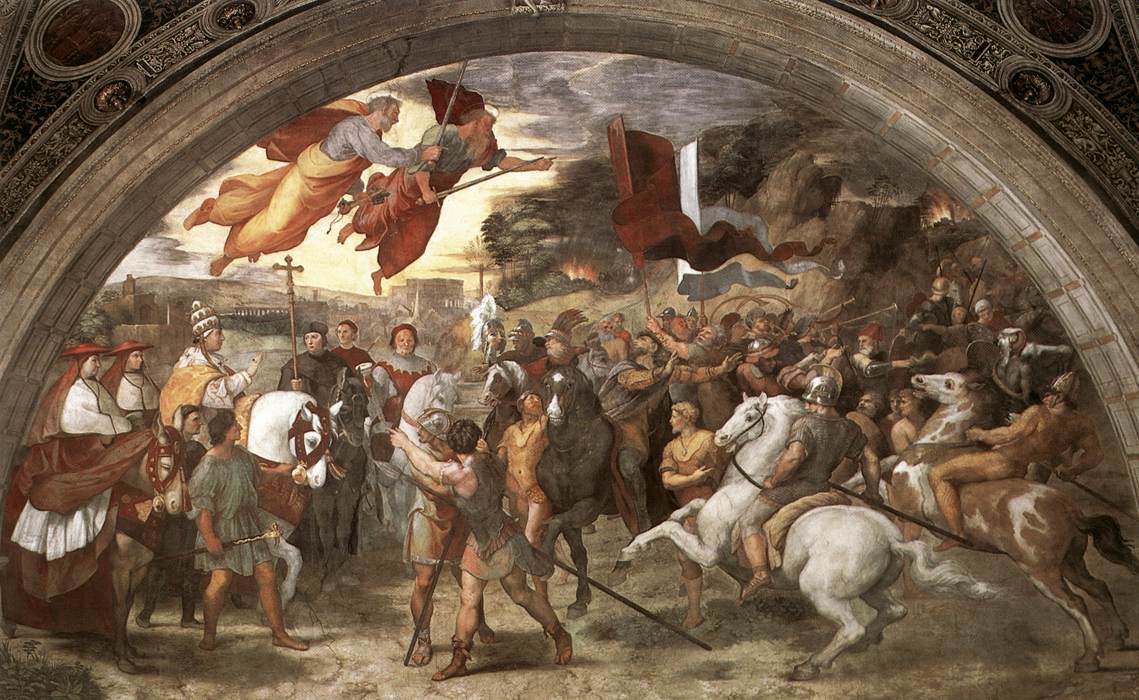
The other response was to fight for the welfare of the population and here we have an image of Pope Leo the Great (440-461).  He defended the city of Rome when it was threatened with destruction on two occasions.  In the year 452 A.D., Attila and the Huns had broken into Italy and sacked cities.  About to do the same to Rome, Leo went out into the mountains to meet Attila and persuaded him not to sack the city by God’s grace.  How was this accomplished?  According to Sr. Catherine Goddard Clark:

“Attila's servants, so the story is told, asked him why he had reversed his custom and capitulated so easily to the Bishop of Rome. The brigand chief answered that all the while the Pope was speaking, he, Attila, the generator of terror in others, was himself consumed in fear, for there had appeared in the air above the Pope's head a figure in the dress of a priest, holding in his hand a drawn sword with which he made as if to kill him unless he consented to do as Leo asked. The figure was that of Peter!"

In 455 A.D. Genseric (Gunderic) the Vandal also threatened to destroy Rome, but this time Leo could only convince the marauders not to destroy the city, which they sacked.  He persuaded Genseric not to mercilessly slaughter the population.  It was the Pope and Christian bishops who remained with the people, stood in the gap and cared for them as good shepherds as the society was disintegrating around them.  Thus, Leo is an example of heroism. 

By the year 476 we have the last of the Roman emperors in the West, Romulus "Augustulus," was deposed by the Gothic king Odoacer.  At that point all of the rulers of the West came from these various tribes.  Christianity was tolerated, somewhat persecuted, but the Western empire was dead.  In the midst of this were seeds of a new birth. Christianity’s task was to convert these conquerors.  Christians were not totally destroyed, though there cities might have been, so there task was to convert these tribes. 

This excerpt from St. Leo's Sermon 2 on the Ascension of the Lord Jesus Christ (Sermo 2 de Ascensione1-4: PL 54,397-399) is used in the Roman Catholic Office of Readings for Friday of the 6th week in Eastertide.  He explains how the Ascenion increases our faith and how our Redeemer's visible presence after the Ascension passes into the sacraments.

At Easter, beloved brethren, it was the Lord’s resurrection which was the cause of our joy; our present rejoicing is on account of his ascension into heaven. With all due solemnity we are commemorating that day on which our poor human nature was carried up, in Christ, above all the hosts of heaven, above all the ranks of angels, beyond the highest heavenly powers to the very throne of God the Father. It is upon this ordered structure of divine acts that we have been firmly established, so that the grace of God may show itself still more marvelous when, in spite of the withdrawal from men’s sight of everything that is rightly felt to command their reverence, faith does not fail, hope is not shaken, charity does not grow cold.

For such is the power of great minds, such is the light of truly believing souls, that they put unhesitating faith in what is not seen with the bodily eye; they fix their desires on what is beyond sight. Such fidelity could never be born in our hearts, nor could anyone be justified by faith, if our salvation lay only in what was visible.

And so our Redeemer’s visible presence has passed into the sacraments. Our faith is nobler and stronger because sight has been replaced by a doctrine whose authority is accepted by believing hearts, enlightened from on high. This faith was increased by the Lord’s ascension and strengthened by the gift of the Spirit; it would remain unshaken by fetters and imprisonment, exile and hunger, fire and ravening beasts, and the most refined tortures ever devised by brutal persecutors. Throughout the world women no less than men, tender girls as well as boys, have given their life’s blood in the struggle for this faith. It is a faith that has driven out devils, healed the sick and raised the dead.

Even the blessed apostles, though they had been strengthened by so many miracles and instructed by so much teaching, took fright at the cruel suffering of the Lord’s passion and could not accept his resurrection without hesitation. Yet they made such progress through his ascension that they now found joy in what had terrified them before. They were able to fix their minds on Christ’s divinity as he sat at the right hand of his Father, since what was presented to their bodily eyes no longer hindered them from turning all their attention to the realization that he had not left his Father when he came down to earth, nor had he abandoned his disciples when he ascended into heaven.

The truth is that the Son of Man was revealed as Son of God in a more perfect and transcendent way once he had entered into his Father’s glory; he now began to be indescribably more present in his divinity to those from whom he was further removed in his humanity. A more mature faith enabled their minds to stretch upward to the Son in his equality with the Father; it no longer needed contact with Christ’s tangible body, in which as man he is inferior to the Father. For while his glorified body retained the same nature, the faith of those who believed in him was now summoned to heights where, as the Father’s equal, the only-begotten Son is reached not by physical handling but by spiritual discernment.


Monday, September 14, 2015

St. John Chrysostom (about 344-407 A.D.)


He was born in Antioch, Syria sometime between 344-354, the date being uncertain despite the large number of biographical sketches of his life. Tutored by his mother at an early age, he went on to formally study philosophy and rhetoric. He was baptized at the age of 18 years old by Bishop Meletius of Antioch and was ordained a lector three years later after studying theology under Diodore of Tarsus.

He spent years as a hermit (monk) outside of Antioch living under the most primitive conditions of deprivation for the sake of the Kingdom (surviving on bread and water) because of the temptations and immorality of the cities, but had to return to society due to severe problems with his gastro-intestinal and kidney functions. He was ordained a deacon in 381 A.D. and by 386 A.D. he was ordained a priest. Serving in the main church in Antioch for the next twelve years, his preaching earned him the title, "golden mouth." He reluctantly accepted the bishopric of Constantinople in 398 A.D., after being summoned to the city by the emperor.

St. John served as Metropolitan Bishop of Constantinople, capital of the Eastern Roman Empire. As the Metropolitan he quickly initiated a reform of the clergy and laity that made his life difficult in the worldly capital of the empire. He emptied the episcopal palace of expensive plate and furniture and built a great hospital for the poor and the suffering his first year. He refused to attend banquets, gave no dinner parties and was benevolent with the poor.

He extended his ministry to the growing numbers of Goths in Constantinople, having a part of the Bible translated into their language. His zeal for evangelization led him to dispatch missionaries to Gothic and Scythian tribes on the Danube. He prohibited applause in Church to increase the solemnity of the liturgy. He generally preferred to give bold sermons on morality. His preaching against the luxury and depravity of the court of Emperor Arcadius earned him the enmity of empress Eudoxia.

St. John attacked by Bishop Theophilus

In 401 at the request of the clergy in Ephesus, he visited the city, where he appointed a new archbishop and deposed six bishops convicted of simony (selling of ecclesiastical pardons, offices or emoluments). John also had a confrontation with the bishop who had presided over his ordination to the bishopric of Constantinople, namely Theophilus of Antioch. The latter, charged by desert monks with persecution of them, had been called to Constantinople by John in 402 A.D. to answer the charges. Subsequently, Theophilus, called together a synod of 36 bishops (mostly from Egypt) who condemned John on 29 charges (including the false charge of treason) and declared him deposed after he refused to appear before them.

St. John Exiled Unjustly for His Moral Courage in Denouncing the Empress

Emperor Arcadius then exiled John to Bithynia, but such was the uproar among the citizens and the fear created by a timely earthquake that the Emperor recalled John after only one day of exile. But the great cleric soon revived the enmity of the Empress when he criticized the reveling that went on near the Cathedral after the erection of a silver statute of the Empress nearby. The Emperor ordered him to retire, but when he refused the Emperor forbade him the use of the city's churches. An outdoor baptismal ceremony at the baths of Constans led to bloodshed when the Emperor's troops broke it up and on June 9, 404 A.D. John was forced to seek exile in remote Cucusus on the eastern frontier of Armenia..

St. John Defended by Pope Innocent I

The Western Roman Emperor Honorius (Arcadius was the Eastern Roman Emperor) and Pope Innocent I tried to summon a new synod on John’s behalf, but the papal legates were imprisoned and sent back to Rome. Innocent broke off communion with both the Patriarchs of Constantinople and Antioch until after John’s death, when his name was restored to the diptychs (i.e., bound manuscript apparently with names of bishops). John's notoriety and accomplishments continued there so his enemies went to the feeble-minded Emperor and persuaded him to banish John to Pityus (Pontus) on the eastern shores of the Black Sea in the Caucasus, but he died enroute on September 14, 407 A.D. His last words were "Glory be to God for all things."

St. John's Body Found to be Incorrupt

St. John may have been dead, but he was not forgotten. St. Proclus, Patriarch of Constantinople preached a sermon glorifying the Saint and the people were so moved that before he finished the sermon he was being urged by the crowd to ask the emperor to have his relics returned to the city. The Emperor Theodosius II, son of Eudoxia, approved and when those sent to get them could not, the emperor immediately send a message begging forgiveness of St. John on behalf of the former emperor and his mother. When St. John’s reliquary coffin was finally brought to the Church of the martyr, St. Irene in 438 A.D., it was opened and his body was found to be incorrupt. Theodosius was said to have approached the coffin with tears and the people remained all night. Then it was transferred to the Church of Holy Martyrs, where the people were said to have cried out, "Receive back thy throne [as archbishop] father!" and the Patriarch and clergy saw St. John open his lips and respond, "Peace be to all."

St. John Unjustly Accused of Anti-Semitism

St. John’s Orations Against the Judaizers has been mistranslated by some to be "Against the Jews" and much of has been made of his strong invective including his use of the word "hate." But in other sermons John is admiring of the "religious devotion and stamina" of the local Jewish community. What he hated were Judaizers attending both synagogue and Mass and persuading others to do the same. Scholars like Robert Louis Wilken in his book, John Chrysostom and the Jews: Rhetoric and Reality in the Late Fourth Century (1983) demonstrate that John was no anti-Semite. His written and oral teaching below emphasize the priesthood's role in the sacrifice of Christ and the real presence of Christ in the Eucharistic Communion.

St. John's Writings:

The Priesthood [386 A.D.]

1118 [3, 4, 177] "When you see the Lord immolated and lying upon the altar, and the priest bent over that sacrifice praying, and all the people empurpled [made purple in coloring] by that precious blood, can you think that you are still among men and on earth? Or are you lifted up to heaven?"

1119 [3, 5, 182] "They who inhabit the earth, they who make their abode among me, are entrusted with the dispensation of the things of heaven! Priests have received a power which God has given neither to angels nor to archangels. It was said to them: 'Whatsoever you shall bind upon earth shall be bound in heaven; and whatsoever you shall loose, shall be loosed' [Mt 18: 18]. Temporal rulers have indeed the power of binding; but they can bind only the body. Priests, however, can bind with a bond which pertains to the soul itself; and transcends the very heavens. Whatever the priests do here on earth, God will confirm in heaven, just as the master ratifies the decisions of his servants. [184] Did He not give them all the powers of heaven? 'Whose sins you shall forgive,' He says, 'they are forgiven them: whose sins you shall retained.' [John 20: 23] What greater power is there than this? The Father has given all the judgment to the Son [John 5:22]. And now I see the Son placing all this power in the hands of men. They are raised to this dignity as if they were already gathered up to heaven, elevated above human nature, and freed of its limitations." 

Wednesday, June 3, 2015

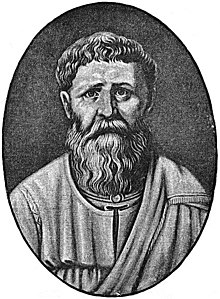
Saint Augustine of Hippo

Augustinus 1.jpgSt. Augustine of Hippo (about 354-430 A.D.)

He has been called the "most erudite" and the "most prolific" of all the Early Church Fathers and the greatest theologian, yet he was a convert to the faith and was not even ordained a priest until 391 A.D. at the age of 37 years old.  He was born in Tagaste, Numidia, a small proconsular city recently converted from Docetism, on 13 November 354 A.D.  to a Christian mother and a pagan father.  Doubtless through the example of his saintly wife, Augustine's father, Patrick, became a Christian before his death in 371 A.D.  At that time Augustine went to Carthage to study advanced rhetoric and prepare for a forensic career.  The next year a son, Adeodatus, was born to him by his concubine.  Although he had been a catechumen, he postponed his baptism in favor of becoming instead a Manichean in 373 A.D.  This sect preached material dualism, claimed to have found contradictions in Holy Scripture and promised scientific explanations for the most mysterious phenomena of nature.
He subsequently returned to Tagaste (now Souk Ahras. Algeria) to "teach grammar" where his mother deplored both his Manichaeism and his concubinage, but on the advice of a saintly bishop, did not keep him from her table.  This was providential because his mother, St. Monica, helped to contrast the truth of Catholicism and her own virtue to the moral depravity and destructiveness of the dualistic philosophy of the Persian sage, Mani or Manichaeism (i.e., Satan was a bad god equal in power to the good God of the Christians).  His disillusionment began when he met Faustus of Milevis, a Manichean teacher, in 383, only to discover his ignorance.

    He went to Italy in 383 A.D. and fell under the teaching of the great Bishop of Milan, Ambrose (two future Doctors of the Church).  He finally converted in April 387 after bringing his son and his mother to Italy the year before.   Monica had prayed for her son for thirty years and was overjoyed, but died at Ostia as they were preparing to return to Africa to the great sadness of Augustine, who expressed his profound grief in his Confessions. 
He returned to Africa where he sold his estate and material possessions planning to study Scripture and live in poverty and prayer, doing good works with his fifteen year old son, who soon died.  In 388 he wrote his work, On the Holiness of the Catholic Church.  After his son died, he became a priest in 391, more because the people who knew him urged Bishop Valerius to ordain him than from his own initiative. He was allowed to preach (something usually reserved to bishops in Africa at the time), becoming an admirable foe of Manicheanism.  He was appointed co-bishop of Hippo in 395 at the age of 41. 
He subsequently made his episcopal residence into a kind of monastery, where he lived a community life with the clergy under a rule of life he authored.  Bishop Possidius named ten saintly friends of Augustine who were themselves elevated to the episcopacy as he became patron to the religious revival in Africa.  He took on the Manicheans converting a great doctor of the sect, Felix, after a debate with him in 404. Having written eloquently on the problem of evil and the misunderstanding of the Manicheans in this area, he also took on the Donatists and the problem of sin.  The Circumcelliones (i.e., brigands) met attempts to bring the Donatists back into the Church with violence and the threats against the bishops' lives, including Augustine.  After some suppression of the Donatists by the Emperor and a major conference in 411 A.D. attended by 286 Catholic and 279 Donatist bishops in which Augustine was prominent, the heresy began to lose strength.
 Augustine had argued that the Church because of its intimate union with Christ (Ephesians 5) is holy and can tolerate sinners within it in the hope of converting them.  Augustine's writings so beautifully developed the theory on the Church that he deserves the designation as "Doctor of the Church" as well as "Doctor of Grace."
Finally, he effectively combat the Pelagian heresy and their denial of original sin and its consequences to man with his work "De naturâ et gratiâ." on the nature of grace.  He played a pivotal role in the papal condemnation of this heresy in 417-418 A.D.  This soldier of Christ spent his last years in combat with the Arian heresy, dying in Hippo in 430 after three months of fervent prayer at the age of 76 years with the city under siege by the Arian Vandals. Some of his prodigious output of writing is quoted below.


Letter of Augustine to Generosus [400 A.D.] on Apostolic Succession

[53, 1, 2] "If the very order of episcopal succession is to be considered, how much more surely, truly, and safely do we number them from Peter himself, to whom as to one representing the whole Church, the Lord said, 'Upon this rock I will build My Church, and the gates of hell shall not conquer it .  Peter was succeeded by Linus, Linus by Clement, Clement by Anacletus, Anacletus by Evaristus, Evaristus by Sixtus, Sixtus by Telesphorus, Telesphorus by Hyginus, Hyginus by Anicetus, Anicetus by Pius, Pius by Soter, Soter by Alexander, Alexander by Victor, Victor by Zephyrinus, Zephyrinus by Callistus, Callistus by Urban, Urban by Pontianus, Pontianus by Anterus, Anterus by Fabian, Fabian by Cornelius, Cornelius by Lucius, Lucius by Stephen, Stephen by Sixtus, Sixtus by Dionysius, Dionysius by Felix, Felix by Eutychian, Eutychian by Caius, Caius by Marcellus, Marcellus by Eusebius, Eusebius by Melchiades, Melchiades by Sylvester, Sylvester by Mark, Mark by Julius, Julius by Liberius, Liberius by Damasus, Damasus by Siricius, Siricius by  Anastasius.  In order of succession not a Donatist bishop is to be found."

[54, 5, 7] "In the first place, I want you to hold as basic to this discussion that our Lord Jesus Christ, as He Himself said in the Gospel, subjected us to His yoke and to His burden, which are light.  He has therefore obliged the society of His new people [New Covenant people] to the Sacraments, very few in number, very easy of observance, and most sublime in meaning.  Such, for example is Baptism, consecrated in the name of the Trinity; the Communion of His Body and Blood and whatever else is commended in the canonical Scriptures, except those things which are read in the five books of Moses [Old Covenant sacraments], which imposed on the old people [Old Covenant people] a servitude in accord with their hearts and the prophetic times in which they lived. But in regard to those observances which we carefully attend and the whole world keeps, and which derive not from Scripture but from Tradition [Apostolic Tradition], we are given to understand that they are recommended and ordained to be kept, either by the Apostles themselves or by plenary councils, the authority of which is quite vital to the Church [assuming here the guidance of the Holy Spirit for the Church].


Letter of Augustine to Jerome [405 A.D.--St. Jerome translated the Bible of his day into the Latin Vulgate, completing it in 405 A.D.]

[82, 1, 3] "I have learned to hold those books alone of the Scriptures that are now called canonical [The Bible canon or listing of inspired books was approved by the Council of Rome in 382 A.D.]  in such reverence and honor that I do firmly believe that none of their authors has erred in anything that he has written therein.  If I find anything in those writings which seems to be contradictory to the truth, I presume that either the codex is inaccurate, or the translator has not followed what was said, or I have not properly understood it . . . .  I think that you dear brother, must feel the same way.  And I say, moreover, that I do not think you would want your books to be read as if they were books of Prophets or Apostles, about whose writings, free of all error, it is not lawful to doubt.  Let us not even think such a thing, in view of your great humility and your true opinion of yourself."

Letter of Augustine to Boniface, A Bishop  [408 A.D.]

[98, 2] "It is this one Spirit who makes possible for an infant to be regenerated through the agency of another's will when that infant is brought to Baptism; and it is through this one Spirit that the infant so presented is reborn.  For it is not written: 'Unless a man be born again by the will of his parents' or 'by the faith of those presenting him or ministering to him', but 'Unless a man be born again of water and the Holy Spirit' [John 3: 5]. The water, therefore, manifesting exteriorly the sacrament of grace, and the Spirit effecting interiorly the benefit of grace, both regenerate in one Christ that man who was generated in one Adam." [Baptism is a gift of God that forgives sin and makes one clean as Adam before the fall]

[98, 9] "Was not Christ immolated only once in His very Person? [sacrificed on the Cross] In the Sacrament [Eucharist or Communion] nonetheless, He is immolated for the people not only on every Easter Solemnity but on every day [in the unbloody sacrifice of the Mass]; and a man would not be lying if, when asked he were to reply that Christ is being immolated [the once, for all sacrifice is never ending or eternal]. For if Sacraments had not a likeness to those things of which they are Sacraments [outward signs] they would not be Sacraments at all; and they generally take the names of those same things by reason of this likeness. Just as the Sacrament of the Body of Christ is in a certain way the Body of Christ, and the Sacrament of the Blood of Christ is the Blood of Christ, so too the sacrament of faith is faith.  To believe, however, is nothing other than to have faith. That is why [at Baptism] response is made that the little ones believe [infants or small children], though he has no awareness of faith. Answer is made that he has faith because of the Sacrament of faith. "

[98, 10] "Although the little ones has not yet that faith which resides in the will of believers, the Sacrament of that same faith already makes him one of the faithful.  For since response is made that they believe, they are called faithful, not by assent of the mind to the thing itself but by their receiving the Sacrament of the thing itself." [Baptism makes them children and heirs: 1 Peter 3: 21; Jn 3: 5; Acts 2: 38]

Letter to the Catechumen Honoratus [412 A.D.--Catechumen is one studying to enter the faith]

[140, 3, 9 ] "This is the grace of the New Testament, which lay hidden in the Old, though there was no end of its being prophesied and foretold in veiled figures so that the soul might recognize its God and, by God's grace, to be reborn by Him.  This is truly a spiritual birth, and therefore it is not of blood nor of the will of man nor of the will of the flesh, but of God.  This is called adoption...."Explanations of the Psalms [inter A.D. 392-418]

[73, 2] "The Sacraments of the New Testament give salvation, the Sacraments of the Old Testament promise a Savior."

[88, 2, 14] "Let us love our Lord God, let us love His Church, Him as a Father, her as a Mother; Him as a Master, her as His Handmaid; for we are children of the Handmaid herself.  But this marriage is held together by great love; no one offends the one and gains favor with the other. . . . Cling, then, beloved, cling all with one mind to God our Father and to the Church our Mother."

Sermons [inter A.D. 391-430]

[20, 2] "If you want God to forgive, you must confess.  Sin cannot go unpunished.  It were unseemly, improper, and unjust for sin to go unpunished. Since, therefore, sin must not go unpunished, let it be punished by you, lest you be punished for it.  Let your sin have you for its judge, not its patron.  Go up and take the bench against yourself, and put your guilt before yourself.  Do not put it behind you, or God will put it in front of you."

"If you believe what you like in the gospels, and reject what you don't like, it is not the gospel you believe, but yourself."


The City of God

Chapter 10, 6
"The wholly redeemed city, the assembly and society of the saints, is offered to God as a universal sacrifice by the high priest who in the form of a slave went so far as to offer himself for us in his Passion, to make us the Body of so great a head . . . Such is the sacrifice of Christians: 'we who are many are one Body in Christ.'  The Church continues to reproduce this sacrifice in the sacrament of the altar so well-known to believers wherein it is evident to them that in what she offers she herself is offered."

Thursday, March 28, 2013

Homily of Pope St. Leo the Great (440-461 A.D.)


This excerpt from St. Leo's Sermon 2 on the Ascension of the Lord Jesus Christ (Sermo 2 de Ascensione1-4: PL 54,397-399) is used in the Roman Catholic Office of Readings for Friday of the 6th week in Eastertide.  He explains how the Ascenion increases our faith and how our Redeemer's visible presence after the Ascension passes into the sacraments.

At Easter, beloved brethren, it was the Lord’s resurrection which was the cause of our joy; our present rejoicing is on account of his ascension into heaven. With all due solemnity we are commemorating that day on which our poor human nature was carried up, in Christ, above all the hosts of heaven, above all the ranks of angels, beyond the highest heavenly powers to the very throne of God the Father. It is upon this ordered structure of divine acts that we have been firmly established, so that the grace of God may show itself still more marvelous when, in spite of the withdrawal from men’s sight of everything that is rightly felt to command their reverence, faith does not fail, hope is not shaken, charity does not grow cold.

For such is the power of great minds, such is the light of truly believing souls, that they put unhesitating faith in what is not seen with the bodily eye; they fix their desires on what is beyond sight. Such fidelity could never be born in our hearts, nor could anyone be justified by faith, if our salvation lay only in what was visible.

And so our Redeemer’s visible presence has passed into the sacraments. Our faith is nobler and stronger because sight has been replaced by a doctrine whose authority is accepted by believing hearts, enlightened from on high. This faith was increased by the Lord’s ascension and strengthened by the gift of the Spirit; it would remain unshaken by fetters and imprisonment, exile and hunger, fire and ravening beasts, and the most refined tortures ever devised by brutal persecutors. Throughout the world women no less than men, tender girls as well as boys, have given their life’s blood in the struggle for this faith. It is a faith that has driven out devils, healed the sick and raised the dead.

Even the blessed apostles, though they had been strengthened by so many miracles and instructed by so much teaching, took fright at the cruel suffering of the Lord’s passion and could not accept his resurrection without hesitation. Yet they made such progress through his ascension that they now found joy in what had terrified them before. They were able to fix their minds on Christ’s divinity as he sat at the right hand of his Father, since what was presented to their bodily eyes no longer hindered them from turning all their attention to the realization that he had not left his Father when he came down to earth, nor had he abandoned his disciples when he ascended into heaven.

The truth is that the Son of Man was revealed as Son of God in a more perfect and transcendent way once he had entered into his Father’s glory; he now began to be indescribably more present in his divinity to those from whom he was further removed in his humanity. A more mature faith enabled their minds to stretch upward to the Son in his equality with the Father; it no longer needed contact with Christ’s tangible body, in which as man he is inferior to the Father. For while his glorified body retained the same nature, the faith of those who believed in him was now summoned to heights where, as the Father’s equal, the only-begotten Son is reached not by physical handling but by spiritual discernment.
             

Saturday, March 10, 2012

St. Gregory of Nyssa


 St. Gregory of Nyssa
  
  St. Gregory of Nyssa is the brother of St. Basil the Great and both are numbered among the so-called Cappadocian Fathers who were renown for their defense of the Holy Trinity.  Another brother of his, Peter of Sebate, was a bishop and his oldest sister, Macrina is recognized as a Saint.

Gregory was himself elevated to the episcopacy in 371 and faced many difficulties including exile. He was falsel accused and deposed as bishop in 376 but returned to his see in 378, after the death of the Emperor Valens. He assisted at the Council of Constantinople in 381, which attempted to put an end to Arianism and Pneumatism in the East. He was renown as an eloquent preacher and writer. Most of his writing was on Scripture and he had a fine sense of the spiritual and mystical sense of Scripture. He himself is called "father of mysticism." 

As a systematic theologian he was the best since the time of Origen, whose work he admired.  This is especially evident in his Great Catechetical Discourse where he laid out the fundamental directions of theology.

On the subject of prayer Gregory writes, "Through prayer we succeed in being with God.  But anyone who is with God is far from the enemy. Prayer is a support and protection of charity, a brake on anger, an appeasement and control of pride.  Prayer is the custody of virginity, the protection of fidelity in marriage, the hope for those who are watching, an abundant harvest for farmers, certainty for sailors."

Thursday, October 6, 2011

Irenaeus of Lyons: A Sketch of a Church Father and His Work

The Life and Work of Irenaeus of Lyons: A Brief Sketch
        Irenaeus of Lyons (130-202 A.D.) was probably a native of Smyrna, Izmir in modern day Turkey.  As a youth he testifies that he listened to the preaching of Bishop Polycarp, who was himself a disciple of the Apostle John.  Writing to the Roman presbyter Florinus, he said,
For when I was still a boy, I knew you in lower Asia, in Polycarp=s house...I remember the events of those days more clearly that those which happened recently... how he [Polycarp] sat and disputed... how he reported his intercourse with John [the Apostle] and others who had seen the Lord, how he remembered their words, and what were the things concerning the Lord, which he had heard from them, from the eye-witnesses of the Word of Life, and reported all things in agreement with the Scriptures.  I listened eagerly even then to these things... and made notes of them, not on paper, but then in my heart and ever by the grace of God do I truly ruminate on them.
He later used Polycarp, whose martyrdom and heroic defense of the faith was legendary, to confront the like of heretics like Marcion and Valentinus.[1]  He says Polycarp once ran into Marcion and called him rightly, “firstborn of Satan.”[2] 
He worked with Bishop Pothinus in Lyons as a presbyter and was probably saved from martyrdom himself when about 177 A.D. Bishop Pothinus sent him with a mission to Rome. By the time he returned the 90 year old Bishop was among about 45 martrys who died in a persecution of the Emperor Aurelius.  Irenaeus was appointed his successor, becoming the second Bishop of Lyons, France.  
Pope Benedict XVI, in his book, The Fathers, says he was ”first and foremost a man of faith and a pastor.”[3]  He soon became immersed in his work of combating the numerous heresies that threatened to destroy the unity of the Church, for which Jesus had prayed (John 17:20-21); a Church which St. Paul described as the "household of God, the pillar and bulwark of the truth" (1 Tim 3: 15). He took seriously the warning of St. Peter in Acts 20: 28-30, "Take heed to yourselves and to all the flock, in which the Holy Spirit has made you overseers, to care for the church of God which he obtained with the blood of his own Son. I know that after my departure fierce wolves will come in among you, not sparing the flock; and from among your own selves will arise men speaking perverse things, to draw away the disciples after them. " 
He was the most important of the second century defenders of the faith and is best known for his great work "Detection and Overthrow of Gnosis Falsely So-Called," but generally referred to as "Adversus Haereses" or "Against Heresies." Pope Benedict says this work can be called “the oldest ‘catechism of Catholic doctrine’”.  The Gnostics he battled against believed that matter was as source of evil and could not have been created by a good God. They claimed special knowledge beyond that of the faith of the Church. Some were ascetics and some were libertine. The epistle of Jude warns against a Gnostic group that was turning the agape love feast into orgies. The Gnostics also claimed that Church doctrines were mere “symbolism for the simple who were unable to grasp difficult concepts” . . .[4]
Sadly the Greek text of his great work is lost to history (last mentioned copy existed in the 9th c.) but the Latin version is available.  It is so literal that to properly understand it, you have to translate it back to the Greek.  Tertullian and many other Fathers used this revered work.  One scholar said of his great work, “He built up a body of Christian theology that resembled a French Gothic cathedral, strongly supported by columns of biblical faith and tradition, illuminated by vast expanses of exegetical and logical argument, and upheld by flying buttresses of rhetorical and philosophical considerations from the outside.  In his own person he united the major traditions of Christendom from Asia Minor, Syria, Rome and Gaul, although his acquaintance with Palestine, Greece and Egypt was minimal.”[5]  Still he well represents 2nd c. Christianity.  The Holy Father calls him the creator of systematic theology, the “first great church theologian.”[6]
In his book Irenaeus of Lyons,  Robert M. Grant observed that Irenaeus apologized for his grammar and rhetorical style:
            You will not expect from us who live with the Celts and most of the time use the language of barbarians either the art of rhetoric which we did not learn, or the skills of a writer we have not exercised, or elegance of language or persuasion which we do not know.  You may, however, accept with love what we have written for you with love, simplicity and truth and, without technique, and yourself develop it, being more capable that we are.[7]
However, what he lacks as a stylist (and he is too modest on that account), he makes up for in the quality of his thought.  Jerome called his style, “most learned and eloquent.”
His view of Scripture is uplifting.  He stresses its divine inspiration again and again, noting, “The Scriptures are perfect, inasmuch as they were spoken by God’s Word and Spirit” (Bk. 2.28.2). He says the Spirit was heralded through the Prophets and announced by the Apostles.  The Word “gave us the fourfold Gospel.” He writes, “Not only the prophets, but the entire Old Testament (O.T.) is prophetic, because the Holy Spirit spoke through all the writers just as He did through the prophets; the writers were His instruments.  Moreover the New Testament is as inspired and divine as the O.T., being equally the word of the Spirit.  The Scriptures are without error, ‘perfect,’ and ‘the mainstay and pillar of our faith.’” He used virtually all the books of the Bible (though the canon was not yet determined) in his defense of the faith and generally did not use apocryphal sources (he did use Henoch once).[8]  Interestingly, he quotes two sayings of Jesus not in canonical books. He usually insisted on the literal sense of Scripture to counter the exaggerated allegories of the Gnostics.  Because the Scriptures are not always clear, he says it is not an absolute rule of faith, but rather we rely upon Tradition, the doctrine of the Church and the rule of Truth itself.  Unlike the Gnostics, Catholic Tradition was public not secret, one not diverse in faith thus creating unity among the people, and emanating from the Holy Spirit not men.[9]  He wrote:
[1, 10, 2] . . . the Church, having received this preaching and this faith ["from the apostles and from their disciples"] although she is disseminated throughout the whole world, yet guarded it as if she occupied but one house. She likewise believes these things as if she had but one soul and one and the same heart; and harmoniously she proclaims them and teaches them and hands them down, as if she possessed but one mouth. For, while the languages of the world are diverse, nonetheless, the authority of the traditions is one and the same."
(See also 2 Thes. 2:15)
He also affirms Apostolic Succession:
[3, 3, 1] It is possible, then, for everyone in in every Church, who may wish to know the truth, to contemplate the tradition of the Apostles which has been made known throughout the whole world. And we are in a position to enumerate those who were instituted bishops by the Apostles, and their successors to our own times: men who neither knew nor taught anything like these heretics rave about.
Since Tradition, derived from Jesus and the Apostles, existed before the writing of the New Testament, he considered it the absolute source of revelation. It is the teaching, he said, of the living Church, even if it had not been written down later.  Moreover that Tradition must come from Rome:
[3, 3, 3] The blessed Apostles [Peter and Paul] having founded and built up the Church [of Rome] handed over the episcopate to Linus [our 2d pope]. Paul makes mention of this Linus in the epistle to Timothy [2 Tim 4:21] To him succeeded Anencletus; and after him in the third place, from the Apostles, Clement. . ." [Peter, Linus, Anencletus and Clement were the first four Bishops of Rome or "Popes." "Pope" is an Italian word meaning "father".  Note: This is also cited in Dei Verbum in footnote 3 to para 7.]
He is revered too because he provides historical witness of the authorship and order of the Gospels:
[3, 1, 1] We have learned the plan of our salvation from none other than those through whom the gospel came down to us. Indeed, they first preached the gospel , and afterwards, by the will of God, they handed it down to us in the Scriptures . . . Matthew        also issued among the Hebrews a written Gospel in their own language, while Peter and Paul were evangelizing in Rome and laying the foundation of the Church. After their departure, Mark, the disciple and interpreter of Peter, also handed down to us in writing what had been preached by Peter. Luke also, the companion of Paul, set down in a book the Gospel preached by him. Afterwards, John, the disciple of the Lord who reclined at His bosom also published a Gospel, while he was residing at Ephesus in Asia.
Salvation history.  Irenaeus once said in his book, Against Heresies, understanding consists in showing why there are a number of covenants with mankind and in teaching what is the character of each of the covenants. If you don’t understand that you have not understood things adequately.  Augustine in the City of God, book X, Sec XIV teaches that salvation history reveals God’s fatherly pedagogy.   In other words God wants to instruct and mature mankind to enter into divine sonship.  So what Irenaeus is saying?  God made these covenants with Adam, Noah, Abraham, Moses David and Ezra and Jesus and we should study the character of each.  For Irenaeus the key word was okonomia, the Greek term is a compound (okos) for family and (nomia) for law. So the economy of grace or the economy of law or the divine economy of salvation, these phrases are used by Irenaeus, who takes the word from St. Paul in 1-2 Corinthians and Ephesians.  This word refers to God’s family plan, God’s household administration.  The Catechism of the Catholic Church (CCC) incorporates this principle at the center of its structure, throughout all four major units. Augustine builds on this and suggest we have a pedagogy (and again the word is derived from St. Paul, this time in Ephesians 3) where he speaks about the law of Moses was a pedagogue, a guardian, a teacher and an instructor, that serves a purpose for a time and having served its purpose, certain laws in the economy of grace can be dispensed (e.g., animal sacrifice, circumcision, the dietary regulations, etc.).  Why? The only way you can understand why the Church felt the freedom to change the laws from Saturday to Sunday, from circumcision to Baptism, from the Passover to the Eucharist, and all the other attendant changes is by discerning the hidden intention of the Divine Teacher and Father. This requires theological exegesis of Scripture. That is really what Scripture calls for.  Scripture is among other things a theological document.  So it is appropriate to study what unifying themes show us about theological unity.  The Church Fathers knew this.[10]
St. Irenaeus, Justin Martyr, John Chrysostom, St. Thomas Aquinas all saw this as did the rabbis like Tuchanides, Namaimodies, Maimonides (d.1204), saw that the literal historical sense of the animal sacrifice and the dietary regulations and other ceremonial laws that Christians are dispensed from, including Sabbath worship, were given to break Israel’s idolatrous attachments to the habits and the gods of the other nations and to prepare them to receive the gift of heavenly glory and divine sonship. 
            Irenaeus wrote Against Heresies to refute the Gnostics by revealing in clear exposition       their errors. Book I is devoted entirely to that objective.  Although much of the work is a refuting of heresy, it contains much positive theology about divine revelation. In Book 2 he refutes the Gnostic belief in two gods chiefly from reason.  In Book 3 he turns to arguments drawn mainly from the Apostles and in Book 4, mainly with the Lord’s words. In Book 5, he explains the salvation of the Body, which the Gnostics adamantly denied. He is a master of figurative language and concrete constructions which are aptly chosen and concisely stated.  For example, he says of God, “He might have indeed been invisible to them because of His eminence, but He could by no means of been unknown to them because of His providence” (Bk 2.6.1).  “God’s friendship bestows imperishability on those who strive for it (Bk 4.13.4) … so that He might become the son of man in turn might become a son of God” (Bk 3.10.2). Professor Scott Hahn is found of this latter saying. He also wrote, “Where the Church is, there is God’s Spirit and where God’s Spirit is, there is the Church and every kind of grace” (Bk.3.24.1).
In reading some of his work Against Heresies we can see his humility and wisdom as he takes on those who presumptuously claim to be familiar with the mysteries of God.  He writes:

If anyone, therefore, says to us, How then was the Son produced by the Father? We reply to him, that no man understands that production, or generation, or calling, or revelation, or by whatever name one may describe His generation, which is in fact altogether indescribable. Neither
Valentinus, nor Marcion, nor Saturninus, nor Basilides, nor angels, nor archangels, nor principalities, nor powers [possess this knowledge], but the Father only who begot, and the Son who was begotten. Since therefore His generation is unspeakable, those who strive to set forth generations and productions cannot be in their right mind, inasmuch as they undertake to describe things which are indescribable... (Book IV, chapter 26, para 6)

Likewise, he argues that we do not know how God produced matter but there are some things we do know:

       For although the Spirit of the Savior that is in Him searches all things, even the deep things of
God, 1 Corinthian 2:10, yet as to us there are diversities of gifts, differences of administrations, and diversities of operations; and we, while upon the earth, as Paul also declares, know in part, and prophesy in part 1 Corinthians 13:9.  Since, therefore, we know but in part, we ought to leave all sorts of [difficult] questions in the hands of Him who in some measure, [and that only,] bestows grace on us. That eternal fire, [for instance,] is prepared for sinners, both the Lord has plainly declared, and the rest of the Scriptures demonstrate. And that God foreknew that this would happen, the Scriptures do in like manner demonstrate, since He prepared eternal fire from the beginning for those who were [afterwards] to transgress [His commandments]; but the cause itself of the nature of such transgressors neither has any Scripture informed us, nor has an apostle told us, nor has the Lord taught us. It becomes us, therefore, to leave the knowledge of this matter to God, even as the Lord does of the day and hour [of judgment], and not to rush to such an extreme of danger, that we will leave nothing in the hands of God, even though we have received only a measure of grace [from Him in this world]  (Book IV, chap 28, para 7).

In conclusion we can only note that the this first of the great theologians was keenly aware that "the Church and the Spirit were inseparable" as Pope Benedict XVI observed. Irenaeus deserves to be remembered for his heroic defense of the faith and his systematic arguments in its defense, especially against the Gnostics.


[1] Marcion wanted a Christianity untrammeled and undefiled by association with Judaism. Christianity was the New Covenant pure and simple. Abstract questions on the origin of evil or on the essence of the Godhead interested him little, but the Old Testament was a scandal to the faithful and a stumbling-block to the refined and intellectual gentiles by its crudity and cruelty, and the Old Testament had to be set aside. The two great obstacles in his way he removed by drastic measures. He had to account for the existence of the Old Testament and he accounted for it by postulating a secondary deity, a demiurgus, who was god, in a sense, but not the supreme God; he was just, rigidly just, he had his good qualities, but he was not the good god, who was Father of Our Lord Jesus Christ.. (Catholic Encyclopedia online).  The Marcionites threw out the gospels and said only the letters of St. Paul were a part of Scripture and they were, in fact, the reason a Council of the Church bishops was called to put together the Canon of the New Testament in the 390's.   
[2] The meeting between Marcion and Polycarp must have happened in 154, by which time Marcion had displayed a great and successful activity, for St. Justin Martyr in his first Apology (written about 150), describes Marcion's heresy as spread everywhere. These half a dozen years seem to many too short a time for such prodigious success and they believe that Marcion was active in Asia Minor long before he came to Rome. (Catholic Encyclopedia online).
[3] Benedict XVI, Pope. The Fathers, Our Sunday Visitor, Inc., Huntington, In., p.24.
[4] Benedict XVI, p. 25.
[5] Grant, Robert McQueen. Irenaeus of Lyons (The Early Church Fathers), New York: Routledge Books, 1997.
[6] Benedict XVI, p. 26.
[7] Grant, p. 47.
[8] “The Book of Henoch enjoyed a high esteem among them, mainly owing to the quotation in Jude. The so-called Epistle of Barnabas twice cites Henoch as Scripture. Clement of Alexandria, Tertullian, Origen, and even St. Augustine suppose the work to be a genuine one of the patriarch. But in the fourth century the Henoch writings lost credit and ceased to be quoted. After an allusion by an author of the beginning of the ninth century, they disappear from view.” It deals mainly with the God’s judgments. Per Catholic Encyclopedia online.
[9] Pope Benedict XVI, The Fathers, pp. 27-29.
[10] Lecture by Professor Scott Hahn in his Theological Foundations course at Franciscan University, 2007.